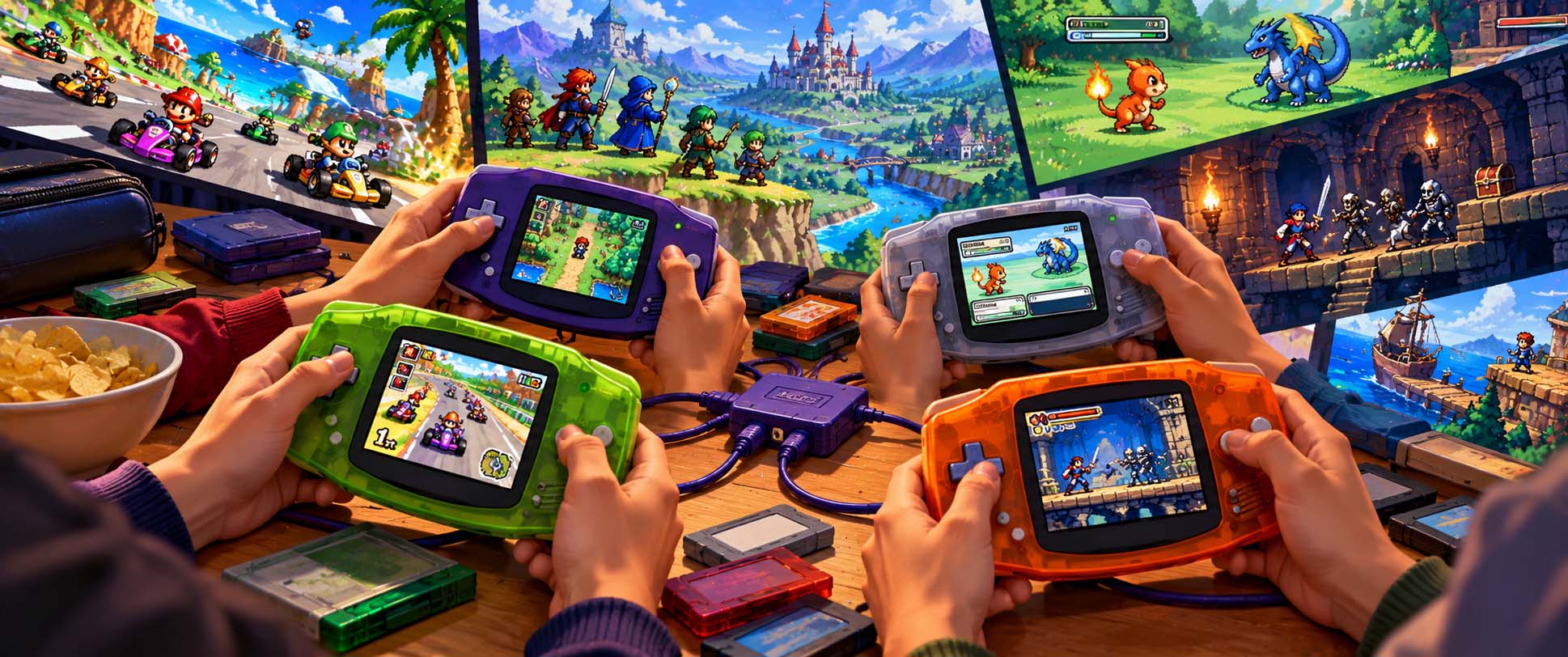
Multiplayer GBA games transformed the Game Boy Advance from a personal handheld into a shared gaming system. Through the GBA Link Cable and compatible games, players could race against friends, trade and battle creatures, cooperate in adventures, or compete directly. Titles such as Mario Kart: Super Circuit, Pokémon, and Kirby & The Amazing Mirror showed how multiplayer could extend replay value beyond a single-player campaign.
This social side of the system mattered because portable gaming no longer had to mean playing alone. Friends with compatible hardware and games could create experiences that changed depending on who joined.
How Did Game Boy Advance Multiplayer Work?
The Game Boy Advance supported local multiplayer through physical connections between compatible systems.
The GBA Link Cable allowed players to connect handhelds, although exact requirements depended on the game. Some multiplayer experiences required each participant to have compatible software, while certain titles supported forms of single-cartridge multiplayer.
This setup feels very different from modern online matchmaking.
Players generally needed to be physically close, connect their hardware, and use whatever multiplayer options a particular game supported. That extra preparation could make multiplayer less immediate, but it also created a distinctly social experience.
The people competing or cooperating were usually sitting near each other.
Multiplayer GBA Games Created Unpredictable Competition
Single-player opponents follow programmed behaviors. Human opponents can make different choices each time.
That difference gives competitive games natural replayability.
Mario Kart: Super Circuit illustrates the appeal well. Learning a course is only part of the challenge when other players influence each race. Competition adds uncertainty because friends may take different lines, make mistakes, or apply pressure at unexpected moments.
The basic tracks and mechanics can remain familiar while the human competition changes.
As a result, multiplayer does not necessarily require enormous amounts of additional content to make a game feel replayable. Other players themselves can provide much of the variation.
Pokémon Made Multiplayer Part of Progression
Pokémon used multiplayer GBA games differently from a traditional racing or action game.
Trading gave players a reason to interact beyond direct competition, while battles allowed them to test teams against another person rather than relying only on computer-controlled opponents.
This strengthened one of Pokémon’s central systems: team building.
A team that works effectively during the main adventure may behave differently against another player’s choices. Human competition encourages players to think more carefully about moves, strengths, weaknesses, and team composition.
Trading also made collecting more social.
Therefore, multiplayer was not simply an isolated mode added to the side of the main game. It connected naturally with collecting, progression, and experimentation.
Cooperative Play Created a Different Kind of Experience
Not every multiplayer experience needs to be competitive.
Cooperative play changes the relationship between players. Instead of trying to defeat one another, they work toward shared objectives.
Kirby & The Amazing Mirror is notable for incorporating multiplayer into its exploration-oriented structure. Multiple players can participate in an adventure where movement, exploration, and action become shared experiences.
Cooperation can create situations that do not occur in solo play. Players may separate, regroup, help one another, or approach areas differently.
This makes multiplayer valuable even for people who are not interested in direct competition.
Multiplayer Helped Some Games Become Game Boy Advance Classics
Long-term appeal is one factor that can contribute to a game’s reputation.
Multiplayer can strengthen that appeal because the experience is not defined only by a fixed story or sequence of levels. Competition, cooperation, trading, and shared discovery can create new memories around familiar mechanics.
When exploring Game Boy Advance classics, multiplayer is therefore worth considering alongside gameplay, genre, replay value, accessibility, and single-player design.
A game does not need multiplayer to become a classic. However, a well-designed multiplayer component can give players additional reasons to keep returning.
The Link Cable Made Portable Gaming More Social
The GBA Link Cable represents an important part of the original multiplayer experience.
Handheld systems naturally emphasize portability and individual screens. Connecting several devices changed that dynamic.
Each player could have a personal display while still participating in the same shared experience. This differed from traditional local multiplayer on a television, where everyone usually watched one screen.
The arrangement offered both privacy and interaction.
A player could make decisions on a personal handheld while remaining part of a larger competition or cooperative session.
That combination became especially useful for games involving individual menus, teams, or information that did not always need to appear on a shared display.
Multiplayer Added Replay Value Without Replacing Solo Play
Strong multiplayer worked best when it complemented the game’s core mechanics.
A racing game could provide enjoyable solo competition and then gain additional unpredictability against friends. Pokémon could offer a substantial individual adventure while using trading and battles to extend its systems socially.
This balance mattered.
Players did not always have friends, cables, compatible cartridges, or additional systems available. Therefore, games that remained enjoyable alone could still provide value when multiplayer was unavailable.
When friends did connect, however, familiar mechanics could take on a different character.
That is one reason multiplayer often increased longevity rather than simply functioning as a separate feature.
Why Local Multiplayer Feels Different Today
Modern multiplayer gaming often emphasizes online connectivity, automatic matchmaking, accounts, and remote play.
The GBA approach was more physical.
Players needed compatible hardware and had to gather in the same place for most multiplayer experiences. That requirement created limitations, but it also shaped how people remember those sessions.
A race against a friend sitting nearby feels socially different from competing against an unknown online opponent. Reactions happen immediately, conversations continue during play, and the gaming session becomes part of a face-to-face activity.
For retro players, this local interaction can be an important part of understanding why certain multiplayer titles developed such memorable reputations.
What Makes a Good Multiplayer GBA Game?
A strong multiplayer game should make interaction between players meaningful.
Competition should allow skill or decision-making to influence the outcome. Cooperative modes should give players useful ways to work together. Trading systems should connect naturally with progression or collection.
Good multiplayer also benefits from understandable rules.
Players should spend more time interacting with one another than struggling to understand what the mode expects them to do.
Most importantly, the underlying gameplay must remain enjoyable. Multiplayer can increase variety, but it cannot fully compensate for weak controls or uninteresting mechanics.
Why Multiplayer Remains Part of the GBA Legacy
The Game Boy Advance is often remembered for its portable single-player adventures, but multiplayer added another dimension to the system.
Racing against friends, trading Pokémon, testing carefully built teams, and cooperating in compatible games turned personal handheld experiences into social ones.
The physical nature of local connectivity also gave this era a distinct identity. Players connected systems and shared a physical space rather than relying primarily on remote online services.
Ultimately, multiplayer GBA games expanded what portable gaming could feel like. By combining individual handheld screens with competition, cooperation, trading, and shared play, they gave many GBA titles additional replay value and helped multiplayer become an important part of the system’s lasting appeal.

