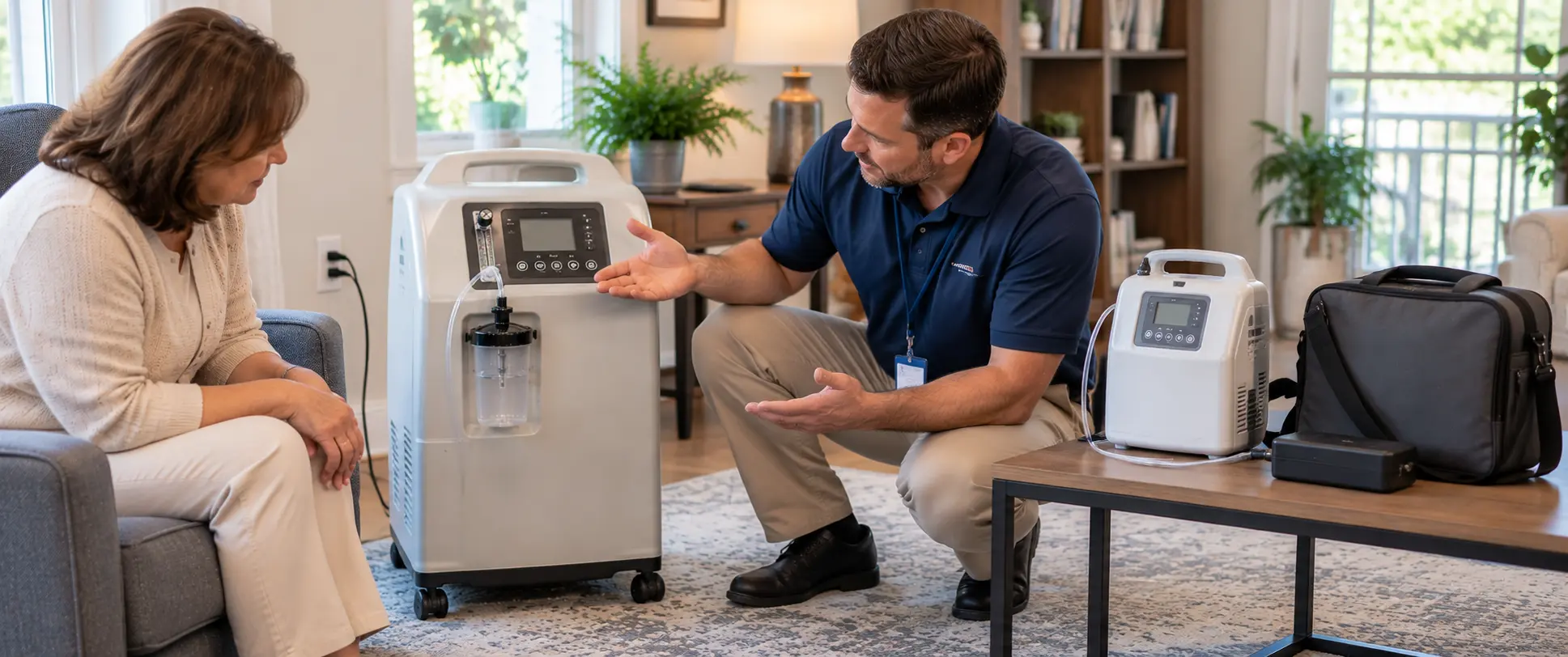
Choosing between stationary vs portable oxygen concentrators depends on the patient’s prescribed oxygen requirements, mobility needs, and intended environment. Both devices produce oxygen-enriched gas from surrounding air, but they differ in size, power supply, oxygen delivery capabilities, and portability.
Stationary concentrators generally support oxygen therapy in homes or care facilities. Portable models, meanwhile, offer greater mobility and may operate using rechargeable batteries.
However, portability alone does not determine which device is appropriate. The most important consideration is whether the concentrator can provide the oxygen delivery that a healthcare professional prescribes.
What Is a Stationary Oxygen Concentrator and How Does It Work?
A stationary oxygen concentrator is an electrically powered medical device that primarily supports oxygen therapy in a fixed location.
These machines draw surrounding air into an internal system that separates much of the nitrogen, producing oxygen-enriched gas.
Many stationary models provide continuous-flow oxygen through compatible tubing and a prescribed delivery interface.
Although some stationary concentrators have wheels and carrying handles, they do not function as lightweight, battery-powered travel devices.
Main Features of Stationary Oxygen Concentrators
Common characteristics include:
- Operation using an appropriate household electrical supply.
- Continuous-flow oxygen delivery on many models.
- Larger compressors and internal components.
- Wheels or handles for movement within a building.
- Manufacturer-defined oxygen concentration and flow specifications.
- Equipment alarms and monitoring features on selected models.
Stationary concentrators often suit patients who primarily need oxygen therapy at home.
However, the equipment must still match the patient’s prescribed requirements.
What Is a Portable Oxygen Concentrator and How Does It Work?
A portable oxygen concentrator provides oxygen-enriched gas while allowing greater movement.
Many portable models use rechargeable batteries, making them suitable for certain activities outside the home.
Their smaller dimensions and carrying options can make transportation more convenient.
However, portable concentrators differ considerably in battery capacity, weight, oxygen delivery technology, and supported settings.
Some provide pulse-dose oxygen delivery, while selected models also offer continuous-flow operation.
Therefore, buyers should never assume that every portable concentrator provides the same oxygen output as a stationary machine.
Main Features of Portable Oxygen Concentrators
Portable models commonly offer:
- Rechargeable batteries for mobile operation.
- Compact designs with carrying handles or shoulder straps.
- Pulse-dose oxygen delivery on many models.
- Continuous-flow options on selected devices.
- External power adapters for compatible electrical supplies.
- Different battery runtime options depending on the model.
These features support mobility. However, the equipment must still meet the patient’s clinical oxygen requirements.
Stationary vs Portable Concentrators: Main Differences
The following comparison highlights important equipment characteristics.
| Feature | Stationary Concentrator | Portable Concentrator |
|---|---|---|
| Primary purpose | Home or fixed-location use | Mobility and travel |
| Power source | Household electricity | Rechargeable battery and compatible external power |
| Equipment size | Generally larger | Generally smaller |
| Oxygen delivery | Often continuous flow | Often pulse dose; some offer continuous flow |
| Mobility | Limited movement within a building | Designed for carrying or transport |
| Battery operation | Usually not built in | Commonly available |
| Operating duration | Depends on electrical supply | Depends on battery and operating settings |
These are general differences. Individual models may offer features outside these typical categories.
Therefore, buyers should compare the specifications of the exact devices they are considering.
Oxygen Delivery: Continuous Flow vs Pulse Dose
The most important difference between concentrators is not simply their physical size.
Instead, buyers must determine whether the equipment supports the prescribed oxygen delivery method and settings.
For example, some patients require continuous-flow oxygen rather than pulse-dose delivery.
A pulse-dose setting does not automatically equal the same numerical continuous-flow setting in liters per minute.
Furthermore, portable equipment may have different delivery limitations during sleep or certain breathing patterns.
Therefore, the prescribing healthcare professional should assess any change between stationary and portable equipment.
Why Oxygen Flow Settings Are Not Always Interchangeable
Continuous-flow concentrators deliver oxygen-enriched gas at a specified flow rate throughout the breathing cycle.
In contrast, pulse-dose concentrators typically deliver oxygen in response to detected inhalation.
These systems use different delivery methods. Consequently, patients should not compare their numerical settings as though they represent identical oxygen delivery.
A healthcare professional must determine whether a particular device provides appropriate oxygen therapy under the patient’s intended conditions.
Comparing Stationary Oxygen Concentrators for Home Use
For patients who require continuous-flow oxygen at home, stationary equipment may provide an appropriate solution when its specifications match the prescription.
For example, a 5L continuous-flow oxygen concentrator such as the Drive DeVilbiss 525KS represents a stationary design intended for home oxygen delivery.
The model provides an adjustable continuous-flow range of 0.5–5 liters per minute under its specified operating conditions.
However, its five-liter maximum flow capacity does not mean it suits every patient.
The prescribing healthcare team must determine whether the equipment meets the individual’s oxygen requirements.
Buyers should also consider the machine’s dimensions, ventilation requirements, operating noise, and electrical compatibility.
Stationary vs Portable Concentrator Power Requirements
Power availability is another major difference between stationary and portable oxygen equipment.
Stationary Concentrators and Household Electricity
Most stationary concentrators require a suitable electrical outlet.
They can operate for extended periods when electrical power remains available and the equipment functions correctly.
However, they generally stop producing oxygen during a power outage unless a compatible external power arrangement supports them.
Patients who depend on continuous oxygen therapy should maintain a clinician-approved backup plan.
Portable Concentrators and Battery Runtime
Portable concentrators commonly use rechargeable batteries.
However, battery runtime varies depending on the device, battery capacity, oxygen delivery settings, and operating conditions.
A battery runtime advertised under one setting may not apply to another.
Therefore, users should review the manufacturer’s runtime information for their prescribed configuration.
In addition, patients should plan for charging opportunities and appropriate backup arrangements when spending extended periods away from home.
Portable vs Stationary Oxygen Concentrators for Travel
Portable concentrators generally offer greater convenience for travel because manufacturers design them with mobility in mind.
However, travel suitability depends on the specific equipment and transportation requirements.
For example, airline travel may involve restrictions concerning accepted devices, battery capacity, and required battery reserves.
In addition, not every portable concentrator supports every oxygen prescription.
Patients should confirm travel arrangements with their healthcare provider, equipment supplier, and transportation company before departure.
A stationary concentrator may be transportable between locations, but its size and dependence on electricity make it less convenient for routine travel.
Can You Take an Oxygen Concentrator on an Airplane?
Some portable oxygen concentrators meet airline requirements, but approval depends on the specific model and applicable aviation rules.
Therefore, travelers should confirm device eligibility and battery requirements with their airline before booking or departure.
They should also discuss their oxygen needs during the flight with their healthcare professional.
A portable device’s suitability for everyday activities does not automatically establish its suitability for air travel.
Can You Use Both Stationary and Portable Oxygen Concentrators?
Some patients use different oxygen delivery equipment for home activities and travel.
For example, a stationary concentrator may support oxygen therapy at home, while an appropriate portable device allows mobility outside the house.
However, both devices must independently meet the patient’s prescribed oxygen requirements.
Their settings are not necessarily interchangeable.
A healthcare professional should assess each device and provide instructions for its intended use.
The U.S. Food and Drug Administration’s guidance on home oxygen therapy explains important considerations for using oxygen concentrators safely under medical supervision.
Common Mistakes When Comparing Oxygen Concentrators
Several purchasing mistakes can lead to unsuitable equipment choices.
- Choosing based only on weight: A lightweight device may not provide the required oxygen delivery.
- Assuming all portable models provide continuous flow: Many portable concentrators use pulse-dose technology.
- Ignoring battery limitations: Portable operation depends on available power and device settings.
- Overlooking electrical requirements: Stationary equipment must work with the intended power supply.
- Comparing only maximum flow ratings: Oxygen delivery method, operating conditions, and clinical suitability also matter.
Avoiding these mistakes helps buyers make more informed equipment comparisons.
Before selecting a model, patients should confirm its suitability with their prescribing healthcare professional and equipment provider.
Choosing Between Stationary and Portable Oxygen Concentrators
The appropriate choice depends on the patient’s medical requirements and daily activities.
A stationary concentrator may suit someone who primarily needs continuous-flow oxygen at home and has access to reliable electrical power.
On the other hand, a portable model may offer practical advantages for someone who needs mobility and can use its oxygen delivery method safely.
Some patients may benefit from having both types of equipment for different situations.
However, equipment selection should always begin with the prescribed oxygen delivery requirements.
After confirming clinical suitability, buyers can compare portability, battery runtime, noise levels, electrical requirements, and maintenance needs.
Final Thoughts on Stationary vs Portable Oxygen Concentrators
Understanding the differences between stationary and portable oxygen equipment helps patients and caregivers identify the features that matter most for home use and mobility.
Stationary models generally emphasize fixed-location operation and continuous-flow capability, while portable models prioritize transportability and battery-powered use.
Neither category is automatically better for every patient.
The appropriate choice depends on prescribed oxygen delivery requirements, equipment specifications, power availability, and intended activities.
By evaluating these factors with professional medical guidance, buyers can select oxygen equipment that supports both clinical needs and practical daily routines.

