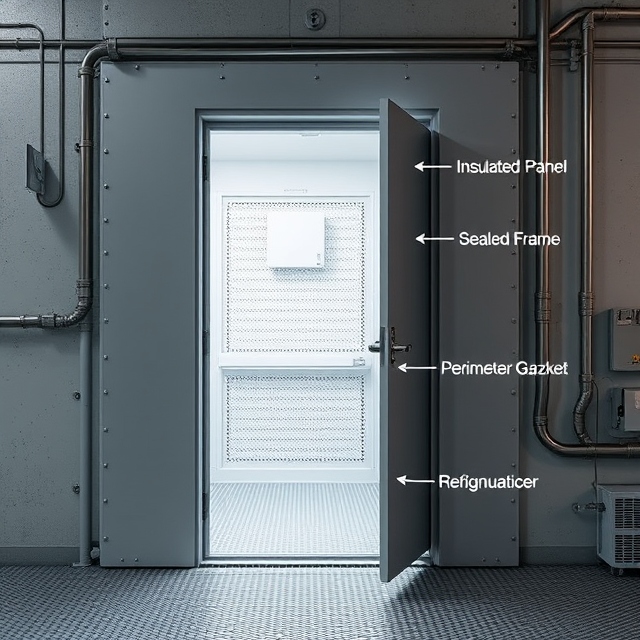
Cold room door insulation plays a central role in maintaining separation between refrigerated spaces and warmer surrounding areas. An insulated door helps reduce heat transfer when closed, but its thermal performance depends on more than the material inside the door panel.
The insulation core, panel construction, frame, seals, joints, and installation all contribute to the effectiveness of the complete doorway. This is why industrial cold-room doors should be evaluated as a complete thermal barrier rather than simply as an insulated slab.
What Is Insulation in a Cold-Room Door?
Cold-room door insulation is the material and construction used to resist heat transfer through the door assembly.
A refrigerated room is maintained at a lower temperature than the surrounding environment. Without adequate insulation, heat can move more easily through the doorway into the colder space, increasing the thermal load placed on the refrigeration system.
Insulated door panels commonly use rigid foam cores enclosed within protective outer surfaces. Polyurethane and polyisocyanurate are examples of insulation materials used in cold-storage construction, although the appropriate material and specification depend on the application.
The National Centre for Cold Chain Development identifies insulated panels with polyurethane-type cores as a common construction approach for cold-storage doors and notes that greater insulation resistance provides better resistance to heat transfer.
How Does Cold Room Door Insulation Work?
Insulation works by slowing conductive heat transfer through the door.
Imagine a freezer room separated from an ambient warehouse. The freezer side is much colder, so heat naturally tends to move toward the colder environment. An insulated door creates greater resistance to that heat flow.
However, the center of the door panel is only one part of the thermal boundary.
Heat can also move through:
- Door frames
- Panel edges
- Fasteners and connections
- Thresholds
- Hardware
- Gaps around the door
- Areas where insulation is interrupted
For this reason, effective cold-room design combines insulated construction with proper sealing and appropriate frame details.
Insulation Materials Used in Industrial Cold-Room Doors
Different insulation materials can provide different combinations of thermal performance, structural properties, cost, and application suitability.
Polyurethane Foam
Polyurethane foam is widely used in insulated cold-room construction. It can form a rigid, relatively lightweight core within a door panel while providing resistance to heat transfer.
Its suitability depends on the formulation, density, panel construction, and operating conditions rather than simply the material name.
Polyisocyanurate
Polyisocyanurate, often called PIR, is another rigid foam insulation used in temperature-controlled construction.
It can be selected where the project specification calls for particular thermal or fire-performance characteristics. The exact suitability should be established from the manufacturer’s technical documentation and applicable project requirements.
Other Insulation Approaches
Some applications may use other insulation materials or composite constructions. The important point is to compare the actual thermal performance of the complete door rather than assuming that one material automatically makes a door suitable for every temperature range.
Understanding R-Value and U-Value
Two terms frequently appear when discussing thermal performance: R-value and U-value.
R-value describes resistance to heat transfer. In general, a higher R-value indicates greater thermal resistance.
U-value describes thermal transmittance, or how readily heat passes through an assembly. In general, a lower U-value indicates better resistance to heat transfer.
These values should be interpreted according to the measurement method and the component being specified. A value for an insulation material is not necessarily equivalent to the thermal performance of the finished door assembly.
This distinction matters when comparing products from different manufacturers.
Why Door Frames Matter
A highly insulated panel can still have weak thermal performance if the surrounding frame creates a significant heat-transfer path or allows air leakage.
The frame connects the door to the wall and forms part of the boundary between the cold room and adjacent space. Its construction should therefore be compatible with the door panel and the operating temperature.
For some cold-storage applications, insulated or thermally separated frame designs can help reduce unwanted heat transfer and condensation around the perimeter.
The frame also needs to support reliable sealing. A door that closes against an improperly designed or damaged frame may allow air to pass around the edges even when the panel itself is well insulated.
Sealing and Insulation Work Together
Insulation primarily addresses heat transfer through the door construction. Sealing addresses air movement around the closed opening.
Both are important.
A gap around a door can allow warmer, moisture-laden air to enter the cold room. In low-temperature applications, that moisture may condense and freeze around the frame, threshold, or gasket.
Common areas to inspect include:
- Perimeter gaskets
- Door-to-frame contact
- Bottom seals
- Corners
- Thresholds
- Sliding guides
- Frame joints
A practical cold-room inspection should therefore check both the condition of the insulation and the effectiveness of the sealing system.
What Is Thermal Bridging?
Thermal bridging occurs when heat finds a relatively conductive path through part of an otherwise insulated construction.
In a cold-room door, potential thermal bridges can occur around frames, metal connections, fasteners, edges, or other components that interrupt the insulated path.
These areas can become particularly important in freezer environments because a cold surface exposed to humid air may encourage condensation or frost.
When evaluating a door specification, it is therefore useful to ask not only, “How thick is the insulation?” but also, “How is the complete assembly designed to manage heat transfer around the insulation?”
Insulation Thickness Depends on the Application
There is no single insulation thickness that is appropriate for every cold room.
A chilled storage area operating above freezing may have different requirements from a freezer or low-temperature storage room. The temperature difference between the two sides of the door, door dimensions, construction, traffic, and operating conditions all influence the appropriate specification.
For example, a facility connecting a moderately chilled room to an ambient warehouse has different requirements from one separating a deep-freeze room from a warm loading area.
The correct specification should therefore be based on the actual design temperature and environmental conditions rather than selecting thickness by rule of thumb alone.
Door Openings Still Matter
Insulation is most effective when the door is closed.
Whenever a cold-room door opens, the insulated panel is no longer separating the two environments. Warm air can enter while cold air escapes, and moisture can move into the refrigerated area.
This is particularly relevant in facilities with frequent forklift or pallet movement.
Research into cold-storage access has identified open-door air infiltration as an important source of thermal exchange, demonstrating why door operation and climate separation need to be considered alongside the physical insulation of the door.
Consequently, a well-designed cold-room access system considers insulation, sealing, opening frequency, operating speed, and traffic patterns together.
Selecting Industrial Cold-Storage Doors
When comparing industrial cold storage doors, insulation should be only one part of the evaluation.
A useful specification review should consider:
Operating temperature: What temperature must the room maintain?
Temperature difference: What environment is on the other side of the doorway?
Door dimensions: What opening width and height are required?
Traffic: Will personnel, forklifts, pallet trucks, or automated equipment use the opening?
Sealing: How effectively does the closed door limit air movement?
Frame: Does the frame construction support the required thermal performance?
Maintenance: Can seals, tracks, hardware, and other components be inspected and serviced?
Door operation: How quickly and reliably does the system open and close?
Looking at these factors together provides a more useful picture than comparing insulation thickness alone.
How Can Insulation Performance Be Maintained?
Even a well-designed door needs appropriate maintenance.
Regular checks can identify damaged seals, misalignment, deteriorating panel surfaces, loose hardware, or frost around the frame before these problems become more disruptive.
Facilities should also keep moving components and sealing surfaces clean and free from obstructions where the manufacturer’s maintenance procedures require it.
If frost repeatedly develops in one area, the cause should be investigated rather than simply removing the ice. The problem could involve air leakage, seal damage, alignment, thermal bridging, or operating conditions.
Final Thoughts
Understanding cold room door insulation means looking beyond the insulation core itself. Thermal resistance, frame construction, sealing, thermal bridging, door operation, and maintenance all influence how effectively a cold-room doorway separates different temperature environments.
For an industrial facility, the most appropriate door specification should be based on the actual temperature range, traffic pattern, opening dimensions, and surrounding conditions. When insulation and the rest of the doorway are designed as one system, the door can provide a more effective thermal boundary while still supporting the practical access requirements of the facility.

